


What Is Bee Pollen?
Bee pollen has been considered one of the most valuable foods in the world because it is a complete and well-balanced concentrate of all the essential nutrients the human body needs. In fact, the French agronomist engineer Ain Cailas, one of the most highly regarded advocates of beekeeping, went so far as to call it a “miracle food,” and the German Federal Health Council has officially recognized it as a medicine since 1977. It contains nearly all the nutrients the human body needs!
Just think: in ancient times, the Egyptians called it “the powder of life”, because it contains all the elements necessary for life: proteins, amino acids, fats, carbohydrates, enzymes, mineral salts, and hormones, present in different proportions depending on the flower from which it is collected.
Thanks to this combination of nutrients, pollen acts as an energizer, stimulant, and tonic for the entire organism: both mentally and physically. This may be why a great doctor from the University of Paris, Ives Donadieu, defined it as “A generator of well-being that acts naturally and harmoniously.”
How Is Pollen Produced?
Pollen is collected three times a year: in April, when spring begins; in June, when the chestnut tree blooms; and in autumn, when ivy is in bloom. It is collected by forager bees, that is, bees that have reached the 21st day of life. They collect grains from flower to flower, grouping them with their little legs until they form one large enough (about 6-8 mg). At that point, they return to the hive, where they store it in the cells.
It is generally produced in quantities greater than the bees' needs, so for us beekeepers it is easy to collect: we simply need to place a grid at the entrance of the hives!
When returning from their working day, which lasts more or less 8 hours, the bees must pass through it to enter the hive, and during this passage, the larger small grains become detached through the small holes and fall into a special container.
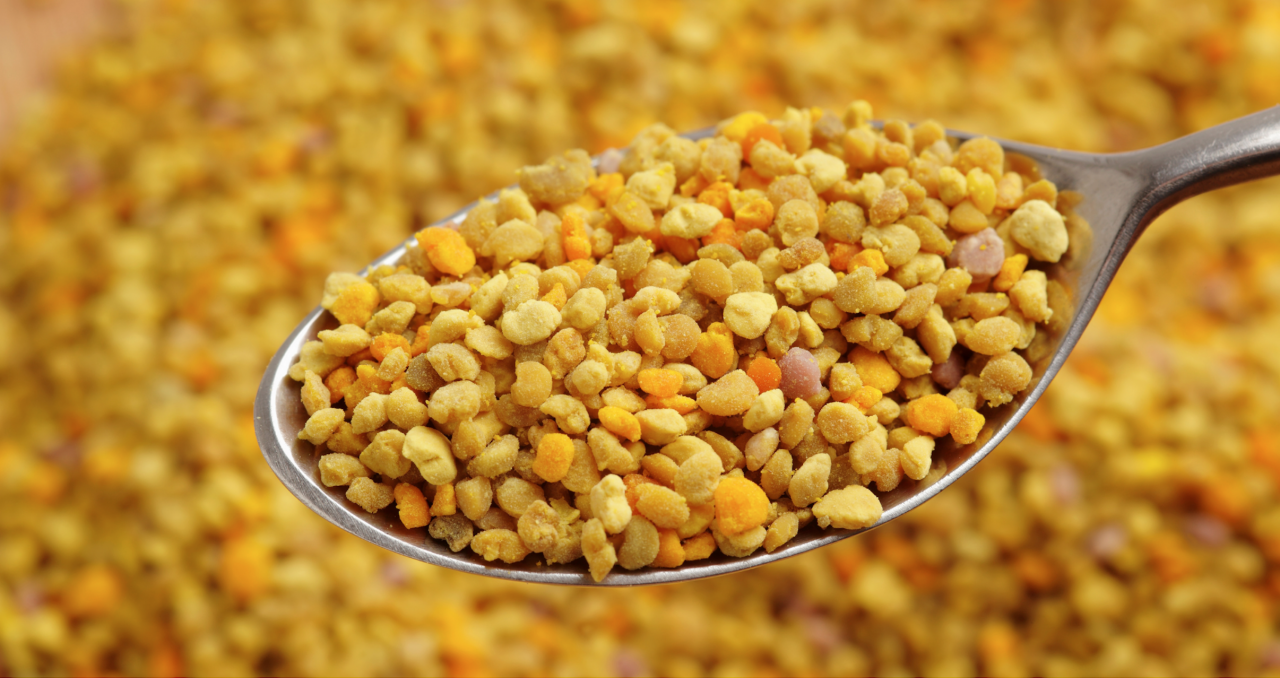
Its colour can vary from yellow to orange to violet because it is collected from the flowers of different plants.
As you will have understood, therefore, it is not a bee product, like honey can be, but instead constitutes the raw material for the production of royal jelly!
What does a pollen grain contain?
Pollen is one of the richest substances in nature. Many consider it a Superfood because of the complete range of nutrients it contains. Each grain contains more than 2 million pollen particles!
It contains everything necessary for life:

Thanks to all these active ingredients, it is an excellent ally for athletes and vegetarians, especially due to its high protein content: it is worth noting that it is higher than that of meat and fish!
What is pollen useful for?
Considered a restorative tonic capable of providing vigour and energy, it can also combat vitamin deficiencies and states of reduced immune defences and energy.
A HELP FOR THE BODY
-
Anti-inflammatory
Being rich in vitamin C , it inhibits the basic mechanisms underlying inflammation
-
Immune system
Ideal during the winter season and seasonal changes for preventing flu and, in general, for convalescence caused by weakened immune systems
-
Detoxifying
Especially recommended during detox periods: thanks to vitamin B3, it cleanses the body of the effects of alcohol and drug consumption
-
Metabolism
It speeds up the metabolism in a completely natural way
A HELP FOR THE MIND
-
Increases energy
Thanks to its high concentration of vitamins C and B and manganese it acts immediately on our vitality, making us feel more active from the first uses, without however stimulating the body (like coffee).
For this reason, it is an excellent aid for students and athletes
-
Depression, nervousness, and insomnia
These disorders are most often caused by deficiencies in vitamins, minerals, and amino acids necessary for the proper functioning of the nervous system. It has been demonstrated that pollen, thanks to its high percentage of these nutrients, helps make up for these deficiencies, consequently improving mood and overall well-being
How should pollen be consumed?
The recommended amount is approximately 15/20 g per day for an adult (1 tablespoon).
To avoid gastric acidity it is recommended to chew it thoroughly or dilute it with warm drinks (water, milk, or herbal tea).
Alternatively, it can also be consumed mixed with honey, jam, or yogurt at breakfast to get the day off to the best possible start!
Consuming it on an empty stomach in fact seems to be the best way to absorb all its nutrients.
Especially recommended during seasonal changes or periods of severe fatigue and psychophysical stress, or alternatively in the case of very frequent sports activities.


